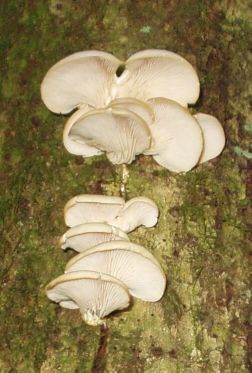
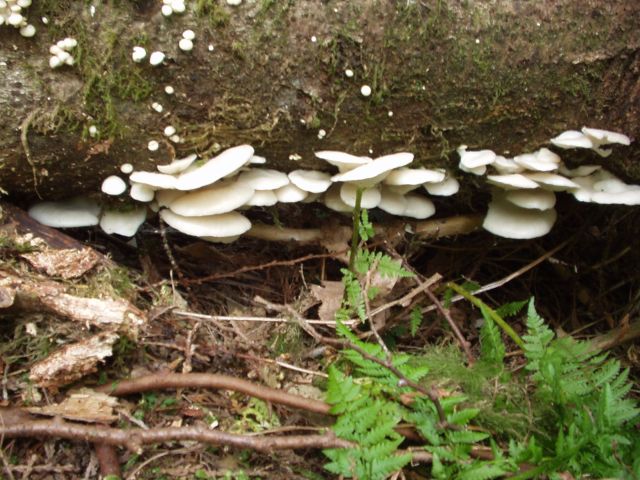
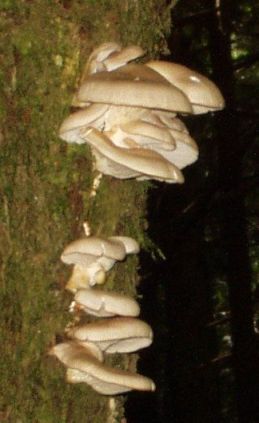
Description: White to brown overlapping mushroom caps laterally attached at one side or by a short, stubby off center stalk to a tree or log.
Season: Fall and spring.
Habitat: Colonies of large overlapping clusters of shelf like mushrooms grow on dead and living broad-leaved tree's. This perennial mushroom is mostly found on standing tree's but also loves damp and rotting logs. Alder logfulls can often be found across Mt. Elphie creeks. Oyster mushrooms have a long life if conditions are right and return year after year. A similar specie, Angel Wings (Pleurotus porrigens), are found on conifers.
Edibility: This mushroom is commercially cultivated and has been hybridized to produce many different varieties and colours. Both wild and cultivated have a mild taste. The small, young ones are best, they get tougher as they get larger and older. The stems should be discarded.
Comments: Oyster mushrooms are commonly cultivated at home by either using commercially bought cultures or wooden plugs or by bringing home a host log and keeping it watered.
DETAILS
Cap: Up to 25 cm broad. Oyster, shell or fan shaped. Sometimes centrally depressed or funnel shaped. White to brownish, smooth and the margin is incurved at first.
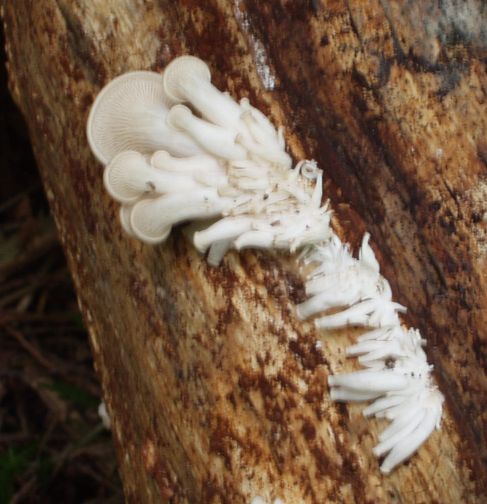
Stalk: 2 - 5 cm x 1 - 2 cm The stalk, if even present, is short, stout, solid and generally off center. Dry, velvety at base and the same colour as the cap. The size of the stalk can depend on the mushrooms position on a log. There will be little or no stem when growing horizontally but if growing off the top of a log, it may have a longer stalk and shape.
Gills: The gills are white when young, close, narrow and soft becoming creamy yellow, broad and distant with age. They are decurrent, extending down any stem to the base of attachment. The stalks often fused together resulting in mushrooms of varying ages clustered together.
Flesh: Thick, white and tender when young with a mild taste and odour.
Spores: 7.5 - 10 X 3.5 - 5µ Elliptical and smooth, whitish to pale lilac/gray. Oyster mushrooms produce many spores. Commercial farm workers have developed 'farmers lung', a respiratory problem, from inhaling too many spores.
Cooking: Oyster Mushrooms are wonderful if simply breaded and fried. First, trim and clean your mushrooms and check for bugs. Use thin portions. Dip in beaten egg and dredge in cracker crumbs. Fry in olive oil or butter and enjoy!